Why “Is This App Safe?” Is the Wrong Question
These platforms weren't designed with your child's wellbeing in mind — they were designed for engagement. A risk comparison of every major app, and what Coptic parents need to understand about the environment they create.
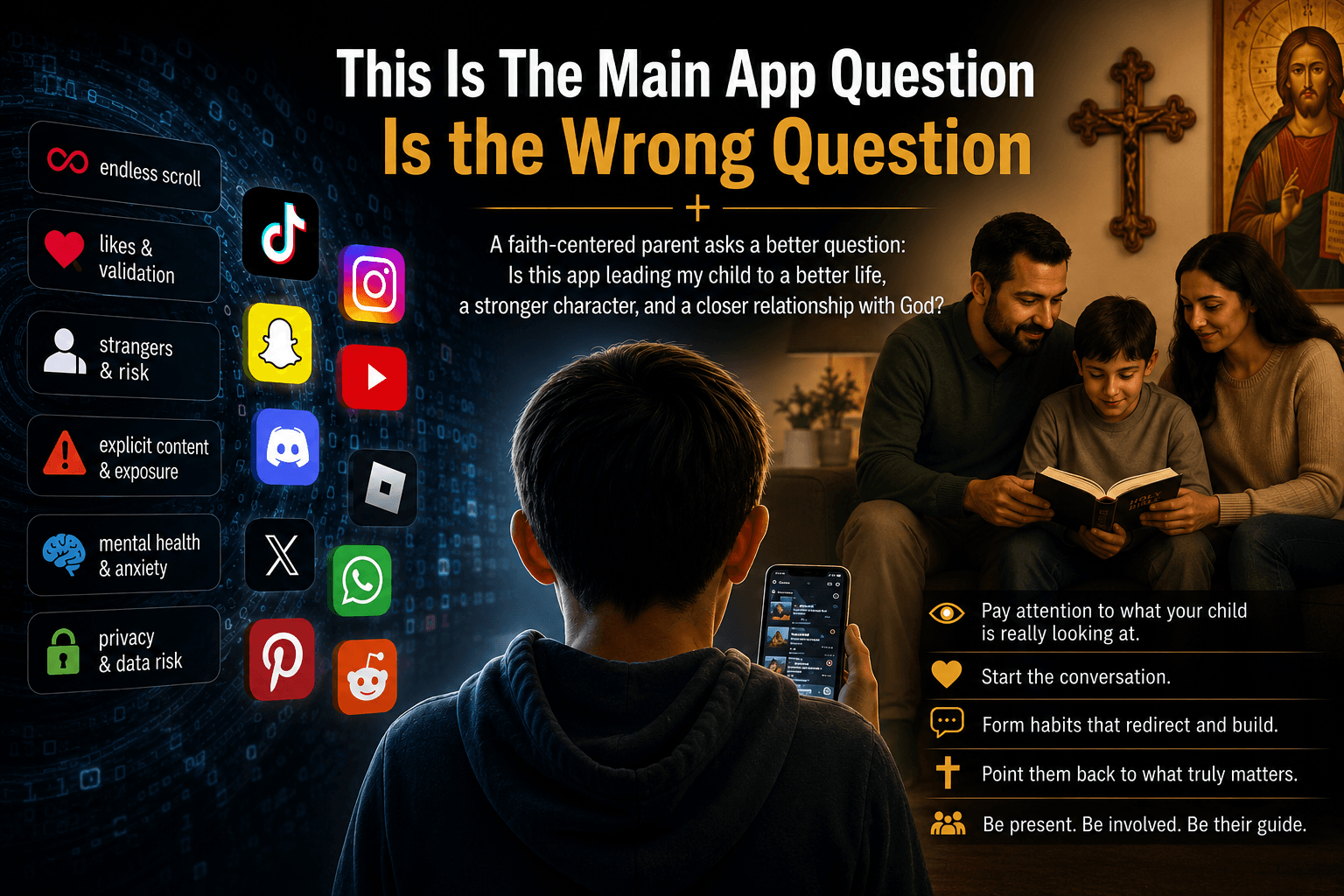
Most parents are asking the wrong question.
They ask: “Is this app safe?”
But that’s like asking if a city is safe without asking which neighborhood, what time, who your child is talking to, and whether the place itself was designed to keep them there as long as possible.
Because that last part is the real conversation we need to have.
These platforms are not built around your child’s wellbeing.
They are built around engagement.
Attention. Time on screen. Emotional triggers. Endless scrolling. The little dopamine hit when a notification comes in. And our kids — whose brains are still figuring out impulse control, identity, and emotional regulation — are far more vulnerable to all of that than we realize.
The danger isn’t just explicit content anymore.
The environment itself is the danger.
And Honestly, Nobody Prepared Us For This
I think about this a lot as a Coptic parent.
We are trying to raise children with roots. With faith. With an identity that goes back centuries. We fast together, we pray together, we take them to liturgy every week and hope something is sticking.
And then they go to their room and spend three hours on TikTok.
That’s not a technology problem. That’s a formation problem.
Because formation is always happening. The question is just — who’s doing it? Us? The Church? Or the algorithm?
If we’re not paying attention, the answer is increasingly the feed.
A Better Way to Think About Risk
Instead of labeling apps as just “good” or “bad,” it helps to look at the actual categories of risk each platform carries. Because every app is different, and every risk is different.
Here are the seven things that actually matter:
- Addictive design — infinite scroll, autoplay, streaks, notification loops
- Stranger access — messaging, voice chat, livestreams, public comments
- Explicit content exposure — how easily harmful content can reach your child
- Mental health pressure — comparison culture, appearance obsession, identity pressure
- Cyberbullying risk — anonymous interaction, harassment, public shaming
- Privacy and data risk — what’s being collected and how it’s used
- Parental controls — whether the tools you have are real or cosmetic
I put together the table below to help parents see all of this in one place.
Social Media Risk Comparison Table for Parents
| Platform | Addiction | Stranger Risk | Explicit Content | Mental Health | Cyberbullying | Privacy | Parental Controls | Overall Risk |
|---|---|---|---|---|---|---|---|---|
| TikTok | High | High | High | High | High | High | Medium | High |
| Snapchat | High | High | High | Medium | High | High | Medium | High |
| High | Medium | High | High | High | High | Medium | High | |
| Discord | Medium | High | High | Low | Medium | Medium | Low | High |
| YouTube | High | Medium | Medium | Medium | Medium | High | Medium | High |
| YouTube Kids | Medium | Low | Low | Low | Low | Medium | High | Medium |
| Roblox | High | High | Medium | Medium | High | Medium | Medium | High |
| Coverstar | Medium | Medium | Low | Medium | Medium | Medium | High | Medium |
| Medium | Medium | Medium | Medium | Medium | High | Medium | Medium | |
| Threads | Medium | Medium | Medium | Medium | Medium | High | Medium | Medium |
| Medium | High | High | Medium | High | Medium | Low | High | |
| X (Twitter) | High | High | High | High | High | Medium | Low | High |
| Medium | Low | Low | Medium | Low | Medium | Medium | Medium | |
| Medium | Medium | Medium | Low | Medium | Medium | Medium | Medium | |
| Messenger Kids | Low | Low | Low | Low | Low | Medium | High | Low |
| BeReal | Medium | Medium | Low | Medium | Medium | Medium | Low | Medium |
TikTok
Snapchat
Discord
YouTube
YouTube Kids
Roblox
Coverstar
Threads
X (Twitter)
Messenger Kids
BeReal
What the Table Doesn’t Show
Here’s something worth saying out loud.
A platform can score “low” on explicit content and still be deeply unhealthy for your child.
Endless scrolling affects attention and impulse control even when every video is completely fine. Follower counts create identity pressure regardless of what the content is about. Streak systems train kids to feel anxious when they don’t log in. Autoplay quietly builds a dependency on the platform itself.
When parents say “my child cannot put the phone down” — that is usually not just a discipline problem.
It is a design problem.
These apps were built by teams of behavioral scientists whose actual job is to maximize the time your child spends on them. Adults struggle with this. Children, whose brains haven’t finished building the systems that resist compulsion, struggle far more.
That’s why “kid-friendly” doesn’t automatically mean healthy. A platform can filter out adult content and still create comparison culture, addiction patterns, and emotional dependency.
The table tells you a lot. But the design problem underneath is something every parent has to understand on its own.
What To Do This Week
Not a long list. Just three things.
1. Look — together.
Sit down with your child and open Screen Time or Digital Wellbeing. Not as a gotcha. As a conversation. What are we spending time on? How does it make us feel after? You’ll be surprised what opens up.
2. Configure, don’t just trust.
Whatever platforms your child is on — spend 20 minutes setting up the actual controls. Family Pairing on TikTok. Contact approval on Roblox. Screen time limits on Instagram. The defaults are not set in your child’s favor. They never are.
3. Have the one conversation.
Not a lecture. A real conversation about what your family values and what you want your home to feel like. Kids who have a clear sense of who they are — rooted in something real — are meaningfully more resilient to all of this.
We have that. Our kids have the Church, the faith, a community, an identity that goes back to the first centuries of Christianity.
That’s not nothing. That’s actually everything.
The Goal Was Never to Ban Everything
Technology isn’t going away. Social media isn’t going away.
The goal isn’t to raise children in a bubble. It’s to raise children with enough rootedness that the algorithm doesn’t become the loudest voice in their life.
That takes awareness. Real boundaries. Ongoing conversation. Staying involved even when it feels awkward.
Because these platforms are not neutral tools.
They are environments.
And as Coptic parents, we have always understood something the tech industry is only beginning to admit:
The environments we place our children in shape who they become.
We just have to be as intentional about the digital ones as we are about everything else.
Tags
Share this post
Comments
Be the first to leave a comment.