Ya3ni, Your Child Doesn't Need a Smartphone Yet: The Complete Guide for Coptic Parents on Waiting Until 8th Grade
A comprehensive guide for Coptic Orthodox parents on why and how to delay giving children smartphones until 8th grade, combining research with our spiritual tradition.

Ya3ni, Your Child Doesn't Need a Smartphone Yet: The Complete Guide for Coptic Parents on Waiting Until 8th Grade
The evidence is in. The conversation is overdue. And no one in our community is having it openly — until now.
Reading time: 18–22 minutes
Who this is for: Coptic Orthodox parents of children ages 8–14
What you'll get: The research, the talking points, the word-for-word scripts, and the practical steps — everything you need to make this decision with confidence and hold the line with love.
Before We Start: A Note on Why This Article Exists
Our priests tell us to pray and fast. Our bishops remind us to raise our children in the fear of God. And they're right — that foundation matters more than anything else.
But between the altar and the dinner table, there's a gap. A very practical, very modern gap that no one in our community is talking about openly: what do we actually _do_ about smartphones?
Not theoretically. Not spiritually in the abstract. Practically. Operationally. What do we say when our 10-year-old tells us every kid in their class has one? What do we say to the tante at church who thinks buying her grandchild the latest iPhone is an act of love? What do we do when our child cries because they feel left out of a group chat?
The priests are right that prayer and fasting are the foundation. And they are not giving us operational frameworks for parenting in the age of TikTok because that is not their job — it is ours, as parents. This article is for that gap.
It is long on purpose — because this topic deserves real depth, not a Facebook post. It is research-heavy on purpose — because your instincts deserve evidence behind them. And it is practical on purpose — because you need tools, not just inspiration.
Let's go.
Should a 10-Year-Old Have a Smartphone?
Research increasingly suggests that unrestricted smartphone access during late elementary school years may create risks children are not developmentally prepared to manage well.
Part 1: What Is "Wait Until 8th" and Why Should Coptic Parents Care?
The Movement
Wait Until 8th is a parent-led pledge movement with a simple premise: commit to waiting until at least 8th grade before giving your child a smartphone. Not a flip phone. Not a basic call-and-text device. A full smartphone — with apps, social media access, an internet browser, and the entire attention economy baked in.
The movement was started in 2017 by Brooke Shannon, a mother of four in Austin, Texas. She realized that most parents didn't actually want to give their kids smartphones in elementary or middle school — they felt pressured into it. The pledge model was her solution: if enough families in the same grade cohort sign on together, the social pressure dissolves. No single child is "the weird one." The norm shifts.
As of 2024, hundreds of thousands of families across the United States have taken the pledge. School districts, pediatricians, and child development researchers have endorsed the framework. And the evidence base behind the "wait" position has only grown stronger.
Why This Is Specifically a Coptic Conversation
Ya3ni, let me say something directly to you, Coptic parent to Coptic parent.
We have something precious. We have a 2,000-year-old tradition of spiritual formation. We have liturgies that train the heart toward stillness. We have fasting cycles that teach the body discipline. We have saints whose entire lives were oriented around guarding the interior life — the nous, as the Fathers called it — from distraction and noise.
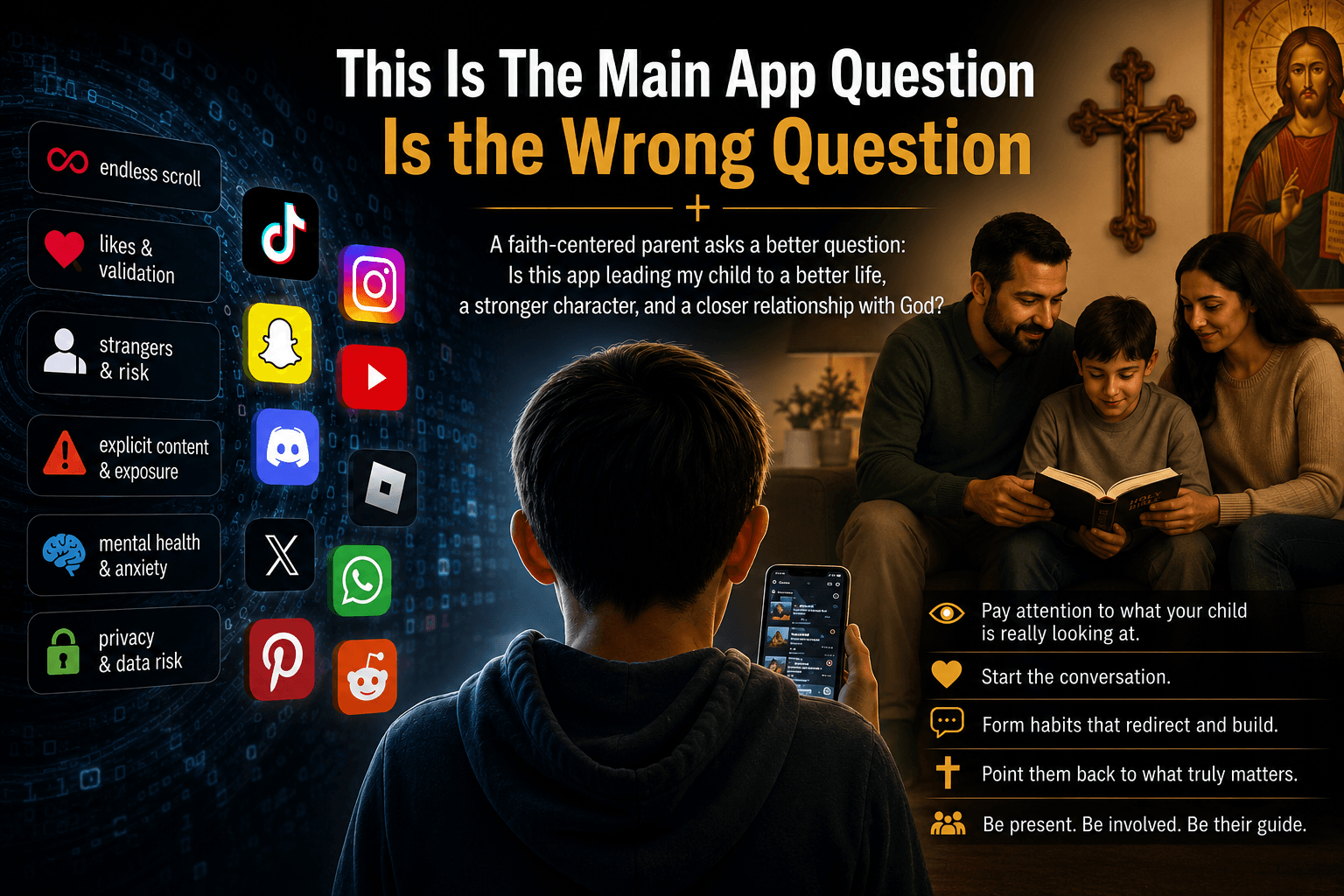
And then we hand our 10-year-old a device that the world's most sophisticated engineers have specifically designed to capture and monetize attention. A device whose entire business model depends on making our children unable to put it down.
This is not a neutral act. It is not just a "parenting preference." It is a spiritual formation decision — and it deserves to be treated as one.
We are not being dramatic. We are being Coptic. And we have 2,000 years of wisdom to draw on when we make this decision. Let's use it.
Part 2: The Coptic Framework — Faith as the Lens, Not Just the Rule
I'm putting this section here, before the research, on purpose. Because I want you to receive the science through the lens of our tradition — not the other way around.
The Desert Fathers Already Knew This
Abba Moses of Scetis — one of the great fathers of our desert tradition — was once approached by a younger monk asking for guidance. His entire reply was this:
"Go, sit in your cell, and your cell will teach you everything."
That's it. Sit in the stillness. Let the silence form you. Stop filling every moment with noise and distraction. The cell — the protected interior space — is where the human person is actually shaped.
Abba Anthony put it even more vividly:
"Just as fish die if they stay too long out of water, so the monk who loiters outside his cell loses the intensity of inner peace."
Neither of these fathers could have imagined a device that follows a child into every room, every moment of boredom, every second of silence — replacing the cell with a feed. But the principle they were describing is exactly what the neuroscience of adolescent development now confirms: the formation of the human person requires protected interior space. What fills that space shapes what the person becomes.
Abba Isaiah said it plainly: "Love to be silent rather than to speak; for silence saves up, but speaking fritters away."
We are raising a generation whose silence is being systematically taken from them — one notification at a time.
The Difference Between Rules and Formation
Many Coptic families operate primarily through rules: no phone, no social media, no this, no that. Rules are necessary. But rules without formation are brittle. A teenager who doesn't have a phone because "Mama said no" is one conversation with a friend away from abandoning that restriction the moment they have independence.
A teenager who understands why — who has been formed in a tradition that values stillness, interiority, and genuine human connection — has a framework they carry inside them. That is what we are aiming for.
On Identity: Who Tells Our Children They Are Worthy?
This is where it gets personal. The mental health crisis driven by social media is, at its core, a crisis of identity. Who am I? Where do I get my sense of worth? The algorithms are built to make children answer those questions by looking outward — at who liked their photo, who left a comment, how many followers they have.
Our answer, as Coptic Christians, is different:
"You are precious in my eyes, and honored, and I love you." — Isaiah 43:4
We are trying to raise children who know — in their bones, not just their heads — that they are beloved children of God. That their worth is not performed, not earned, not subject to an algorithm. Social media is a direct attack on that formation. Not because it is evil in itself, but because its business model depends on creating in your child the opposite conviction: that they are only as valuable as their engagement metrics.
And then we bring them to liturgy and tell them otherwise. We are fighting a battle on two fronts — and we need to know it.
The Scene We Don't Talk About
Here is the moment every Coptic parent knows but nobody says out loud: the Sunday morning sermon, and the soft glow of screens from three rows back. Kids scrolling. Sometimes even young adults. The priest is speaking. The incense is rising. And a 12-year-old is watching YouTube.
This is not a failure of faith. It is a failure of formation — and it starts years before Sunday morning. A child who has spent six years building the habit of reaching for a phone the moment they feel bored or restless does not suddenly have a different nervous system inside the church. The habit comes with them.
Protecting the childhood — protecting the interior space before the habits are carved in — is how we protect their ability to be present. In church. At dinner. In real conversation. In prayer.
Part 3: The Research — Explained Like We're Having Coffee
Okay, habibti. Here's what the scientists have actually found. I'm going to give you the numbers, the sources, and what they mean for your specific child. Every claim links to the original research.
3.1 The Brain Is Still Under Construction
The single most important fact here is this: the adolescent brain is a construction site.
The prefrontal cortex — the region responsible for impulse control, long-term planning, resisting peer pressure, and weighing consequences — is not fully developed until approximately age 25. During the adolescent years, the brain is literally being rewired. Connections are being pruned. Neural pathways are being solidified based on what the brain is exposed to and what it practices.
Social media platforms and smartphone apps are designed to exploit the brain's dopamine reward system — the same system that underlies addiction. Every notification, every like, every new post triggers a small dopamine release. For a fully developed adult brain, this is manageable. For a 12-year-old whose impulse control circuitry is still being built, this is genuinely not a fair fight.
And here's the thing parents need to hear: when your child says "I can handle it," they are not lying. They genuinely believe they can. But the part of their brain responsible for accurately assessing their own capacity for self-regulation is the exact same part that isn't finished yet. This is not a character flaw. It is developmental biology.
Read the research:
3.2 The Mental Health Numbers Are Not Subtle
For decades, teen mental health in the United States was relatively stable. Then around 2012, something broke. Depression rates among adolescents began climbing sharply. Anxiety surged. Rates of self-harm among teenage girls hit levels researchers had never seen before. Loneliness increased even as teens reported spending more time "connected."
So scientists started digging. What they found should make every parent stop.
2012 was the year smartphone ownership among American teenagers crossed the 50% threshold.
That's not a coincidence. That's a signal. Here's what the major studies found:
Dr. Jean Twenge, San Diego State University
Twenge analyzed data from over 500,000 adolescents and found:
- Teens spending 5+ hours per day on devices were 66% more likely to have at least one suicide risk factor compared to those spending 1 hour or less.
- Even 2–3 hours per day was associated with significantly higher rates of depression, loneliness, and unhappiness.
- The effects were stronger for girls than boys across every measure.
- The correlation held even after controlling for other variables — meaning smartphones weren't just a symptom of already-unhappy teens. They were a contributing cause.
Source: Twenge, Martin & Campbell (2018), Clinical Psychological Science
Dr. Jonathan Haidt, New York University
Haidt's 2024 book The Anxious Generation synthesizes global data and reaches a direct conclusion: the smartphone-based childhood that began around 2012 has been — his words — "a collective developmental disaster."
His key findings:
- The mental health deterioration happened simultaneously across the English-speaking world, tracking smartphone adoption rates. It is not an American cultural problem. It is a technology problem.
- The crisis hit girls first and hardest, but has since spread to boys as well.
- The mechanism is not just screen time — it's the specific nature of social media: social comparison, public performance of identity, cyberbullying, and the displacement of face-to-face interaction.
- Countries and schools that have restricted smartphone access show measurably better mental health outcomes.
His recommendation: No smartphones before high school. No social media before 16.
Source: The Anxious Generation (2024) — full research database
JAMA Pediatrics
A study published in JAMA Pediatrics followed over 6,500 adolescents and found that frequent social media use increased sensitivity to social rewards over time — meaning the brain literally became more dependent on external validation (likes, comments, peer approval) for its sense of self-worth the more it was used.
Source: Valkenburg et al. (2021), JAMA Pediatrics
3.3 Sleep: The Hidden Casualty
This one hits different when you think about your child specifically.
Adolescents need 8–10 hours of sleep per night. Most are getting significantly less — and the phone in the bedroom is a major reason why.
- Teens with phones in their bedrooms sleep an average of 20 to 46 fewer minutes per night than those without. (Falbe et al., 2015, Pediatrics)
- The blue light emitted by screens suppresses melatonin production, biologically delaying the onset of sleep.
- Social media checking at night activates the stress response — even briefly checking a notification puts the nervous system on alert.
- Sleep-deprived adolescents show reduced function in the prefrontal regions we discussed above — compounding the developmental vulnerability.
The practical implication is simple: a phone in your child's bedroom at night is a sleep disorder in progress. And a chronically sleep-deprived child cannot learn, cannot regulate their emotions, and cannot be fully present — at church, at school, or at home.
Source: American Academy of Pediatrics — Media and Young Minds
3.4 The Phone Doesn't Even Have to Be On to Do Damage
This finding surprised researchers when it came out, and it surprises most parents too.
A 2017 study from the University of Texas at Austin had participants complete cognitive tasks with their phones either on the desk face-down, in their pocket, or in another room entirely. The result: participants whose phones were in another room significantly outperformed those with phones on the desk — even when all phones were face-down and silent.
The brain is constantly exerting cognitive effort just to resist checking the phone. That effort is no longer available for thinking, learning, or being present.
For a child trying to study, or trying to listen in class, or trying to sit in church — the phone doesn't have to be in their hand to be doing damage. Its mere presence is a tax on attention.
Source: Ward et al. (2017), Journal of the Association for Consumer Research
3.5 Real Friendship Is Getting Crowded Out
One of the most consistent findings across all this research: heavy smartphone use crowds out the in-person social connection that actually builds healthy development.
- Between 2012 and 2019, the percentage of teens who reported getting together with friends in person nearly every day dropped by approximately 40%. (Twenge et al., 2019, Child Development)
- Teens report feeling more lonely than previous generations, despite being more "connected."
- The skills that in-person friendship builds — reading facial expressions, tolerating awkward silences, managing conflict, developing empathy — require practice. That practice is being displaced.
For Coptic families whose community life depends on genuine in-person connection — at liturgy, at youth meeting, at family dinners that go four hours long — this matters. We are trying to form children who know how to be present. The smartphone works against that in ways that accumulate quietly over years.
Part 4: The Objections — Every Argument You'll Hear, and How to Answer It
"But everyone else has one."
This is the most common argument you will hear — from your child, from other parents, and honestly, sometimes from the voice in your own head at 11pm when you're second-guessing yourself.
Let's take it seriously. According to surveys, while smartphone ownership among middle schoolers is widespread, a significant and growing minority of families are waiting — or wish they had. The "everyone has one" perception is partly a social media illusion: the kids with phones talk about it constantly; the kids without phones are simply living their lives.
The Wait Until 8th insight is important here: the pledge model works precisely because it changes the social math. When 8–10 families in the same grade cohort sign on together, the "everyone has one" argument collapses. Your child is no longer the exception. They're part of a group. And that group can be your church community.
Script for your child:
"You're right that a lot of kids have phones. You're also right that it can feel lonely to be different. That's actually why we're going to talk to some families from church about doing this together — so you're not alone in it."
"What about safety? What if I need to reach them?"
The most legitimate concern, and it deserves a real answer.
The key is separating two conversations that get collapsed into one: communication and a smartphone are not the same thing.
Alternatives that give you communication without the full internet:
- [Gabb Wireless](https://gabb.com/) — a phone that looks normal but has no social media, no internet browser, no app store. Calls and texts only. Designed specifically for kids. Under $15/month.
- [Pinwheel](https://www.pinwheel.com/) — a parent-controlled smartphone where you approve every single app. Children get a functional device; parents control what's on it.
- [TickTalk 4 Smartwatch](https://www.ticktalk.us/) — GPS tracking, two-way calling, SOS button. No apps. No internet. Around $20/month.
- Basic flip phone — pay-as-you-go, under $10/month, boring by design. Boring is a feature.
Script:
"We want you to be able to reach us — that's exactly why we're getting you a [Gabb/watch/flip phone]. But a smartphone with Instagram is a completely different conversation, and we're not there yet."
"Won't they just be behind when they finally get one?"
No. And the research is clear.
Digital literacy is not something that requires years of unsupervised practice to develop. The skills required to use a smartphone responsibly — judgment, self-regulation, understanding of privacy, awareness of manipulation — are not built by having a smartphone at age 11. They're built by cognitive and emotional development over time.
A 16-year-old who gets a smartphone for the first time learns to use the interface within days. What takes longer to develop — and cannot be shortcut — is the interior life that uses the tool wisely. That interior life is built in childhood. Protecting the childhood builds the foundation.
"What if they just use their friends' phones?"
This is a real possibility. Name it directly.
Script:
"I know you might use phones at school or at friends' houses sometimes. I'm not trying to control every second of your life. What I want is for your default — the thing you reach for when you're bored, lonely, or anxious — not to be a social media feed. That habit is what we're protecting you from building right now."
Research on habit formation shows that the habits built in adolescence are significantly more durable than those formed in adulthood. The goal is not perfect isolation from technology — it is preventing the formation of the reflexive habits that smartphones are specifically designed to create.
"My child says they'll use it responsibly."
They mean it. And it's almost certainly not true — not because they're bad, but because of developmental biology.
The prefrontal cortex — responsible for self-regulation and accurate self-assessment — is unfinished. Studies consistently show adolescents overestimate their own ability to regulate behavior, especially around high-stimulation environments. And the smartphone is specifically engineered by teams of the world's most talented behavioral scientists to defeat adult self-regulation.
Script:
"I believe you want to use it responsibly. I also know these apps are designed by some of the smartest people in the world specifically to make that really, really hard — even for adults. We're not saying you're irresponsible. We're saying the deck is stacked."
The In-the-Moment Conversations (The Ones That Actually Happen)
The initial conversation is one thing. Here are the moments that catch parents off guard:
Your child comes home upset because a group chat happened without them:
"That sounds genuinely painful, and I'm sorry. Can you tell me what happened? ... I hear you. Being left out hurts. And I also want you to know that what we're doing at home isn't going away — but how I can support you through moments like this absolutely matters to me."
They find out a close church friend just got a phone:
"I know. That's hard when it feels like the gap is growing. Here's what I want you to know: [friend's family] made the decision that's right for them, and we've made the one that's right for us. Both families love their kids."
They catch you on your phone during family time: This one is not a script. This one is a mirror. Put the phone down. Say, "You're right. I'm sorry." And mean it. Your modeling matters more than any talking point in this article.
They say "you just don't trust me":
"I trust you completely. I don't trust the companies that built these apps. There's a real difference."
Part 5: A Word About Extended Family
Here's the Coptic-specific friction point nobody writes about: the grandparents. The aunts. The uncles.
In our community, giving a child a nice phone is an act of love. It is a gift. It communicates "I see you, I want you to have what the other kids have, I want to video call you whenever I want." And the teta who just spent $800 on an iPhone for her grandson is not being malicious — she is being generous by the standards of her framework.
But her framework was formed in a world where phones were phones. She does not know about dopamine loops or the attention economy or the JAMA Pediatrics study. She knows she loves her grandchild.
This means you need to have the extended family conversation before a birthday or Christmas arrives with a smartphone in a box. Not as a confrontation — as a connection.
How to approach it:
"Mama/Baba/Tante, we're doing something as a family — we've decided to wait until [child] is in 8th grade before getting a smartphone. It's not that we think phones are bad — it's that we've been reading about what they do to kids' brains at this age and we want to be careful. We'd love your support. If you want to give [child] a gift they'll love, [alternative idea] would mean so much."
Give them something to say yes to. People don't like being told what not to do — they like being invited into something. Frame it as a family decision they can be part of, not a rule they need to comply with.
Part 6: What Are We Protecting Them For? (Not Just From)
This article has spent a lot of space on what we're protecting our children from. Let's spend a moment on what we're protecting them for — because that's ultimately the more important question.
A childhood with protected interior space looks like something. It looks like:
Boredom that becomes creativity. The research on boredom is surprising: children who are allowed to be bored develop stronger imaginative capacity, better self-direction, and more intrinsic motivation. Boredom is not a problem to be solved by a screen. It is the precondition for creativity. When your child complains they're bored and you resist the urge to hand them a device, you are doing them a genuine favor they cannot yet see.
Friendships with real depth. The friendships formed face-to-face — through shared boredom, through conflict and repair, through sitting together in silence, through inside jokes that developed over years — are qualitatively different from friendships maintained through group chats. Our children deserve both, but the in-person kind needs to be prioritized and protected.
A nervous system that can sit still. The capacity to sit in liturgy for two hours. To pray the Agpeya without reaching for a phone. To sit with a grandparent and have a real conversation. To tolerate silence without anxiety. These capacities are not automatic — they are formed through practice. A childhood with space for silence is practice for the rest of life.
An identity that doesn't need to perform. A child who has not spent formative years curating an Instagram presence has a different relationship with their own identity. They are more likely to know who they are apart from what others think of them. That is exactly the kind of person our faith is trying to form — someone whose identity is rooted in being known by God, not performed for an audience.
Presence at the table. The families who describe the richest family life are almost universally families who protect family time from devices. The dinner table. The car ride. The late-night conversation that starts accidentally and turns into something real. These moments require presence — and presence requires that the phone be somewhere else.
Part 7: The Practical System — What to Actually Do
Step 1: Get on the Same Page as Your Spouse First
Before you say a word to your child, get genuinely aligned with your spouse or co-parent. Children are skilled at working the gap between two parents who aren't synchronized. You should both be able to explain the why in your own words.
If you disagree, spend time with the research together before making any decisions. Read The Anxious Generation together. Go through Part 3 of this article side by side. The data is persuasive when you actually sit with it.
Step 2: Have the First Conversation With Your Child
Do not announce a rule. Have a conversation. Here is a full framework:
Open by making them a partner, not a subject:
"I want to talk to you about something I've been reading a lot about. Not to lecture you — I actually want to hear what you think. Can we talk about smartphones for a bit?"
Share the research in their language:
"Did you know there are scientists who've spent years studying what these apps do to kids' brains? What they're finding is that Instagram, TikTok, Snapchat — they're built to make it really, really hard to put them down. Like, on purpose. The people who make them study psychology and use it to keep you scrolling. Even adults struggle with it."
Connect it to your faith:
"You know how we talk about guarding our hearts? About being careful about what we let in? Our faith has been saying this for 2,000 years. Turns out the scientists are saying the same thing, just in different words."
State the decision clearly and honestly:
"So here's what we've decided: we're going to wait until 8th grade before you get a smartphone. That doesn't mean no technology — [here is what you will have instead]. And it doesn't mean we'll never talk about this again. It means we're being intentional about the timing."
Actually listen to their response:
"What do you think? What worries you most about this? I want to hear it."
And then genuinely listen. Not to be moved off the decision — but because their concerns are real and they deserve to be heard. You can hold the line and still validate the feeling.
Step 3: Organize Within Your Parish — This Is Your Most Powerful Tool
The pledge works best collectively. And our community is already organized. Use it.
A concrete action plan:
- Identify 2–3 other Coptic families in your child's grade who you think might be sympathetic. Have a casual conversation after church or over coffee. "Have you been thinking about the smartphone thing? I've been reading some things I want to share."
- Share this article (or the Wait Until 8th pledge page) with them. Don't pressure — inform. Let the research do the work.
- Propose a parent gathering — informal, even on a WhatsApp call — specifically for parents of kids in that grade. Frame it as a conversation, not a campaign.
- Take the pledge collectively. If 5–8 families in the same grade commit together, the social landscape for your children changes. They are no longer outliers. They are a cohort making a shared choice.
- Talk to your Sunday School servants or youth director. Propose phone-free retreats. Propose a parent workshop on technology and faith formation. Many servants are hungry for this conversation and have no framework for it. You bringing the framework is a gift to them.
- Create a grade-level parent WhatsApp group specifically for coordinating on this. Share resources. Check in. Support each other when kids push back — because they will.
Step 4: Set Up Your Home Environment
If your child doesn't have a smartphone yet:
- Charge all devices outside bedrooms. Every night, all devices — including yours — charge in a common area. This is a household norm, not a punishment. Model it yourself.
- Designate phone-free times. Meals. Car rides when possible. Family conversation time. Make these sacred and consistent.
- Make the alternative visible and appealing. Books. Board games. Space for creative projects. Art supplies. The goal is not deprivation — it is redirection toward better inputs. Fill the space intentionally.
If your child already has a smartphone:
It is not too late to reset. Research shows that even partial reductions — removing specific apps, set time limits, phones out of bedrooms — produce measurable improvements in mood, sleep, and wellbeing within weeks.
Concrete steps:
- Remove social media apps. Not "limit" — remove. Instagram, TikTok, Snapchat, BeReal. If your child needs to access these, they can do so on a home computer where usage is visible and less habitual.
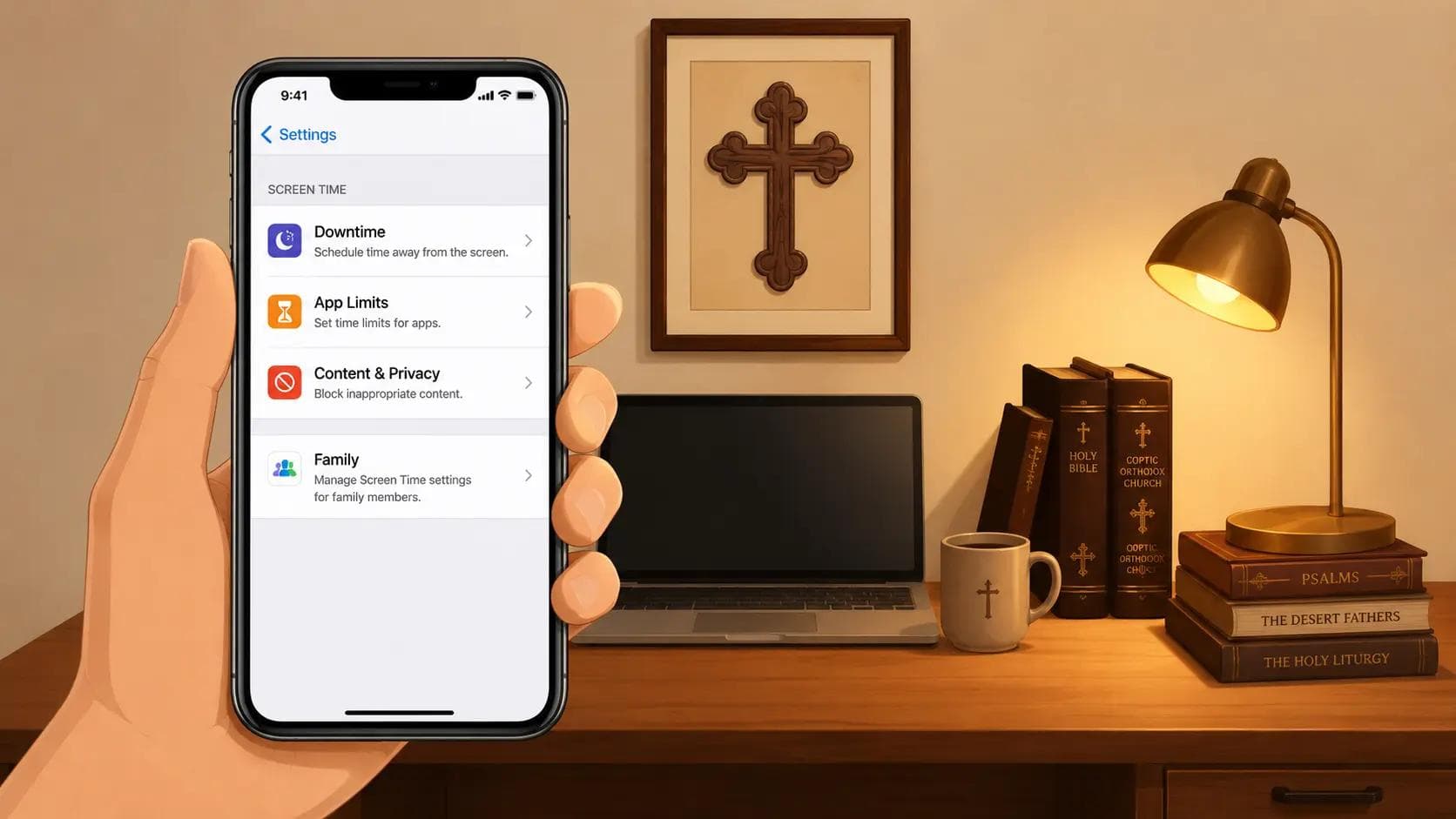
- Enable Screen Time (iOS) or Digital Wellbeing (Android) with limits on app categories. Set downtime from 9pm to 7am — no apps except calls and messages.
- Move the charger out of the bedroom. Single highest-impact change according to multiple studies. Do this first.
- Have a reset conversation — not a punishment announcement. "I've been reading some things and I think we set this up in a way I regret. Here's what I want to change, and here's why. I want to talk about it with you, not just impose it."
Step 5: Stay Consistent and Expect Pushback
Your child will push back. Expect it. It does not mean you are wrong.
"You're so controlling."
"I know it feels that way. And one of the things I'm responsible for as your parent is protecting you from things that could genuinely harm you, even when you can't see the risk yet. I'd rather you be frustrated with me now than struggling with something harder later."
"Everyone else is allowed to."
"More families than you think are doing the same thing we are. And even if they weren't — we don't make decisions based on what everyone else is doing. We make decisions based on what we believe is right for our family."
"I'll just use my friend's phone."
"Maybe. And that's okay sometimes. What we're trying to prevent is having that habit in your pocket 24 hours a day. That's different from occasionally using someone else's device."
Step 6: Give It a Clear Horizon
"Wait until 8th grade" is not "never." That matters enormously to a child.
Give them a specific, honored endpoint:
"When you start 8th grade, we'll sit down together, look at how things have gone, and make the smartphone decision together. Your voice will matter in that conversation."
This makes the waiting finite and meaningful. It signals that you see this as an ongoing relationship, not a permanent decree. Children handle limits significantly better when they can see the endpoint — and when they believe their future input will be heard.
Part 7: FAQ for Coptic Parents
Q: What about using a smartphone for the Agpeya or the Coptic Reader?
A: This is one of the most common questions in our community, and the answer is simple: a tablet handles this perfectly. A dedicated iPad or Android tablet can run the Coptic Reader app, the Tasbeha app, the Agpeya, and the full Bible — without cellular connectivity, without an app store full of temptations, and without a social media algorithm. Consider a tablet the "faith technology" device in your home and keep it distinct from a personal phone. Many families find this framing actually elevates how children relate to the device — it becomes something used for a purpose, not for entertainment.
Q: My child's school says they need a smartphone for assignments.
A: Schools that genuinely require a personal smartphone for academic work are rare. Almost all legitimate educational needs can be met with a tablet or a home computer. If a teacher or school is requiring a personal smartphone, it is worth having a direct conversation with administration — most will accommodate a family's preference for an alternative device. If a specific app is required, check whether it runs on a tablet before assuming a phone is necessary.
Q: My child is being cyberbullied. Does this change anything?
A: Yes — and it actually strengthens the case for removing access rather than managing it more carefully. If a child is the target of cyberbullying, the most protective intervention is removing the device from unsupervised use, not monitoring it more closely. This is not a punishment for the child — it is the same logic as taking someone out of a dangerous environment while you address the danger. The problem is not your child. The problem is the environment, and you have the right and the responsibility to change it.
Q: What about YouTube? My child uses it constantly.
A: YouTube is one of the most sophisticated algorithmic recommendation systems ever built, specifically designed to maximize watch time. A child who opens YouTube to watch one video about Minecraft and 45 minutes later is watching something unrelated and increasingly extreme is not weak — they are encountering a system that has been optimized by thousands of engineers and billions of data points to produce exactly that outcome. Unlimited YouTube access for children under 13 is not safe. YouTube Kids is an imperfect but better alternative for younger children. For middle schoolers, supervised YouTube on a home computer — not on a personal phone in a bedroom — is the appropriate boundary.
Part 8: Resources for Coptic Parents
Start Here — Books
- The Anxious Generation by Jonathan Haidt (2024)
- iGen by Jean Twenge (2017)
- The Tech-Wise Family by Andy Crouch (2017)
The Research, Directly
- Wait Until 8th — Pledge & Research Hub
- Jonathan Haidt's Research Database
- Twenge & Campbell (2018) — Clinical Psychological Science
- Valkenburg et al. (2021) — JAMA Pediatrics
- Ward et al. (2017) — Brain drain study
- Twenge et al. (2019) — In-person socializing decline
- NIH Adolescent Brain Cognitive Development Study
- American Academy of Pediatrics — Media Guidelines
Child-Safe Communication Alternatives
Conclusion: You Are Not Alone in This
Here is what I want you to leave this article knowing:
Your instinct to wait is correct. The developmental science supports it. The mental health research supports it. And our faith tradition — 2,000 years of wisdom about how human beings are formed — supports it completely.
You are not being extreme. You are being thoughtful. There is a difference, and it matters.
The gap between the altar and the dinner table is real. The priests give us the foundation. We have to build the house. And building the house in the 21st century means making hard, countercultural decisions about technology — with love, with patience, with evidence, and with community.
Hold the line. Explain the why. Model the behavior you want to see. Organize within your parish so no family has to do this alone. And give your child the gift of a childhood with a little more silence, a little more presence, and a little more room to actually become who God made them to be.
They will thank you for it. Maybe not at 13. But they will.
If this article was helpful, share it with two Coptic families you know.
May God grant wisdom to every Coptic parent trying to raise their children in truth and love. Pray for us, O Mother of God.
Ⲭⲉⲣⲉ Ⲙⲁⲣⲓⲁ
Tags
Share this post
Comments
Be the first to leave a comment.